 |
Monday, April 2, 2018
Find purpose in life and be happy!
The April 1 Edition of "Finding Happiness in America" newsletter is out. Click HERE to view it! We hand-pick relevant articles and videos from over 150 domestic and foreign news sources.


Thursday, November 30, 2017
CANINE COMPANIONS ENRICH PEOPLE'S LIVES
 |
| Mandy Mueller raises puppies that enrich people's lives |
Quiche is a 7-month old Golden Retriever
who will, someday soon, make a big difference in someone’s life. She is being
trained by Sandusky County resident Mandy Mueller, a volunteer “Puppy Raiser”
for Canine Companions. Founded in 1975, Canine Companions is a non-profit
organization that provides highly trained assistance dogs for the ongoing
support to people with disabilities.
Canine Companions also recognizes the
brave men and women returning home from combat with disabling injuries who experience
a litany of new challenges when trying to transition back to civilian life. Their
exciting new pilot program in California places service dogs with veterans suffering
from PTSD. Maybe, when Quiche is fully trained, she may help a veteran who is dealing
with difficult emotions that are bottled up inside.
These new PTSD
assistance dogs are being trained in nightmare interruption,
turning on lights, retrieving items, and comforting PTSD-stricken veterans in
crowded public situations that might provoke their anxiety. They hope to expand this project to include
paramedics, police officers, firemen and other first responders who also suffer
from PTSD.
Mandy Mueller explained the details as to
how these amazing canines are trained. She teaches Quiche social skills,
manners and 30 vital commands. For example, “Under!” instructs her to crawl
under a chair, table or pew in a restaurant, church or at any public meeting so
people don’t trip over her. “Up!” tells her to hold her front paws up
vertically, like on a wall, for she will be further trained to use her nose to flip
on a light switch or activate an automated door opener for a disabled person.
Canine Companions is the oldest and
largest provider of assistance dogs in the world, currently raising and
training 1,316 puppies with over 3,000 active volunteers nationwide. Mandy
Mueller will keep Quiche until she is 18 months of age. During that time, Quiche
enjoys a safe home, healthy diet, and much socialization and love. Their time
together is vital to the development of a future assistance dog and she submits
monthly reports on Quiche’s progress to Canine Companions.
Labrador Retrievers, Golden Retrievers and
a cross of the two are bred to be assistance dogs. Volunteers nurture the
newborn puppies for eight weeks, then volunteer “Puppy Raisers” spend the next
14-18 months providing basic obedience training, socialization and special
care.
For example, Mandy attends Canine
Companions approved obedience classes, pays for Quiche’s puppy food, medical
and transportation expenses, provides a kennel or crate for sleeping indoors,
and exposes her to everyday life experiences and socialization opportunities
such as public events and medical appointments. She always keeps her on a leash
unless she’s in a securely fenced area and generally supervises the young Golden
Retriever throughout the day.
It’s all worth it! These remarkable dogs
make life easier for so many in need. They may retrieve a dropped phone, pull a
wheelchair along, open doors, alert a deaf person to important sounds, wake someone
up on time, comfort a child in a medical setting or prisoner in the criminal
justice system, or enable children with disabilities to do something they never
had the courage to do.
If you’d like to donate to or learn more
about Canine Companions, contact Mandy Mueller at (smmueller22@gmail.com) or
Staicey Scholtz, President of the Northern Ohio Chapter at (ylwlabs2@gmail.com).
Robert
Morton, M.Ed., Ed.S. has retired from his positions of school psychologist for
Fremont City Schools and adjunct professor in the School of Leadership and
Policy Studies at Bowling Green State University. He authored two books:
“Finding Happiness in America” and the spy thriller “Penumbra Database.”
Sunday, November 12, 2017
Finding Happiness in America! Nov. 12, 2017 Issue

November 12, 2017 Issue of "Finding Happiness in America" is out! You can be happy if you find yourself alone at times. Keep travelling your journey and keep doing what you think is right and doing what you think will make you successful. This issue has info on finding happiness in a marriage, which may be easy or an uphill task. This seems to be everybody’s dilemma in finding happiness whether married or not. Finding happiness in a marriage or any relationship for that matter is possible. However, whether it is easy or difficult depends on your attitude and actions.
The
I hope you enjoy this November 12, 2017 Issue of "Finding Happiness in America." Enjoy!
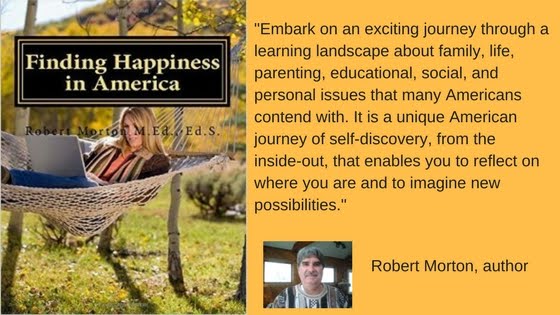
Robert Morton, M.Ed., Ed.S. is retired and is author of the book "Finding Happiness in America."
Friday, August 19, 2016
TEACHING CHILDREN MONEY-MANAGING SKILLS
Neither high rollers or skinflints, the have-nots or affluent money managers are born that way...they're made. Most acquired either virtuous or harmful money habits as children by observing their parents. Why should we instill sound money management principles in our kids? The answer is simple. In today's world, many of us can become economic have-nots without really trying.
In my book, "Finding Happiness in America," much time is spent on how we can teach our children good money-management skills. With ATM's, easy credit, a bounty of "pre-approved" credit cards flowing into our mailboxes, and slick TV advertising unduly convincing us (and our kids) that we need things which we really don't, it's paramount that we instill in our impressionable children an understanding of finances and wise money management.
Since our kids learn how to manage money mostly by watching how we manage ours, we can make a big difference in preparing them to recognize and defeat the debt-influencing forces which have overpowered many of us. Child specialists and financial advisors recommend four key strategies to prepare kids to become masters, not slaves, to money:
Strategy No. 1: Hold family financial meetings and introduce the basics of household budgets: the inflow outflow equation: Your kids should know the  sources of the family income, a "ballpark" numerical figure or general description of how much money comes in each month, how much is saved, and how much goes out of the family reserve. If financial difficulties have fallen upon you, don't overwhelm your children with the potential catastrophic consequences; Just briefly spell out how you plan to get out of it and that you can't make undue sacrifices to give them everything they've been used to getting.
 sources of the family income, a "ballpark" numerical figure or general description of how much money comes in each month, how much is saved, and how much goes out of the family reserve. If financial difficulties have fallen upon you, don't overwhelm your children with the potential catastrophic consequences; Just briefly spell out how you plan to get out of it and that you can't make undue sacrifices to give them everything they've been used to getting.
Strategy No. 2: Use a "hands-on" approach and consider your children's maturity and developmental levels of understanding when teaching the income  outgo budget equation. As younger children learn basic arithmetic, however, you can give them a "feel" for the family budget money drain from check writing and teller machine withdrawals by going over the receipts, charge bills and checking account statements. Likewise, older children and teens aren't totally aware that continual use of the credit card means we pay for today's purchases with tomorrow's income, and that today's family outgo is paying for past credit card purchases. Our 14 million high schoolers spent close to $100 billion last year for food, clothes and entertainment, mostly via credit cards.
 outgo budget equation. As younger children learn basic arithmetic, however, you can give them a "feel" for the family budget money drain from check writing and teller machine withdrawals by going over the receipts, charge bills and checking account statements. Likewise, older children and teens aren't totally aware that continual use of the credit card means we pay for today's purchases with tomorrow's income, and that today's family outgo is paying for past credit card purchases. Our 14 million high schoolers spent close to $100 billion last year for food, clothes and entertainment, mostly via credit cards.
Strategy No. 3: Develop a positive attitude toward money  management by practicing what you preach. Most parents aren't the greatest money managers, so try to "Walk the Talk." Kids and teens are apt to pick up inconsistencies when we say one thing and do another. When shopping, spend extra time to teach children how to read labels and compare prices. Cut out store "specials" and coupons from newspapers, have them locate these deals at the store, and explain why you buy one brand over another.
 management by practicing what you preach. Most parents aren't the greatest money managers, so try to "Walk the Talk." Kids and teens are apt to pick up inconsistencies when we say one thing and do another. When shopping, spend extra time to teach children how to read labels and compare prices. Cut out store "specials" and coupons from newspapers, have them locate these deals at the store, and explain why you buy one brand over another.
Strategy No. 4: Give your children an allowance, and structure it so they must manage it themselves. Ironically, less than a third of all U.S. children get a  weekly allowance, even though experts agree that it is the gateway to developing sound budgeting and spending skills, and can be started as early as age 5. With some ground rules established, decide with your children what the weekly allowance is to cover.
 weekly allowance, even though experts agree that it is the gateway to developing sound budgeting and spending skills, and can be started as early as age 5. With some ground rules established, decide with your children what the weekly allowance is to cover.
Then, establish prearranged times for payments. With younger children, start with bi-weekly allowance payments, then gradually increase the payments to weekly intervals. As they grow older, most teens can budget successfully with monthly allowances. Always make allowance payments on the same day, so they can pace themselves and securely plan their spending and savings. Encourage them to consider how they will spend, save, and share their money.
 Give younger children a transparent container to store the allowance in, and give them coins, not bills. In this way, they will concretely feel the weight, hear the jingle, and see their shiny accumulations when they save and their disappearance when they overspend. If your child wants a candy bar, comic book, or a mechanical hobby horse ride at the grocery store, simply state, "Use your allowance money, honey." If the piggy bank is empty, that is the end of the matter.
Don't use the allowance as a means for punishment or as payment for household chores. Remember, your giving your children a regular, predictable income so they may learn to make consistent money management decisions. You can pay kids for special or extra jobs around the house, but routine household chores should be expected, without pay.
Your early efforts in teaching young children that money doesn't grow on trees or magically spring from the deepest recesses of your pockets should make money management easier for them later on.
Hopefully, by teaching our children the relationships between postponing gratification, budgeting, spending and saving, our children will discover something which many adults have not...that money makes a terrible master but a magnificent servant.
Robert Morton, M.Ed., Ed.S. has retired from his positions of School Psychologist and adjunct professor in the School of Leadership and Policy Studies at Bowling Green State University. He is author of the book "Finding Happiness in America."
Sunday, June 19, 2016
Parenting children is tough job!

Parenting is
one of the toughest jobs in the world and no User’s Guide or operating manual accompanies
it. There’s no way to be a perfect parent but there’s a million ways to be
a good one. This article is for dads, too, for they are increasingly taking on
more essential child-raising responsibilities
Nevertheless,
studies show dad’s place in the modern parenting landscape remains a smaller
one than mom’s, particularly if he plays golf (Excuse me while I duck).
In my book,
“Finding Happiness in America,” I mention how parenting effectiveness can be
enhanced if four basic tenets are honored. After 34 years of counseling parents
and children, I noted four child-rearing themes that cropped up over and again
among parents of happy and confident kids. Regardless if their children ranged
in physical qualities from homely to comely or chubby to svelte, were smart to
empty-headed, or clumsy to athletic, these parents respected them for who they
were and allowed them to be themselves. I'd like to share them with you:
- They allowed their children to develop at their own pace and appreciated them for who they were. The children weren’t the best at all things but they had a spirit that made them unafraid to try and make the best of their capacities and opportunities. Although Dr. Benjamin Spock’s “Bible” on parenting, “Baby and Child Care” is somewhat outdated, I continue to enjoy his words. Spock wrote, “Love and enjoy your children for what they are, for what they look like, for what they do, and forget about the qualities they do not have.”
2.
I noticed these parents enjoyed all of their children unconditionally.
Sensing they would grow up quickly and be gone too soon, they kept diaries,
took pictures, compiled photo albums, and filmed videos of events and moments
which they knew would soon fade into memories.
3.
They seemed relaxed, regardless of their children’s
shortcomings, and didn’t pressure their kids to be the best athlete, smartest
classmate, or the most musically talented. Instead of pushing or forcing their kids
into things, they seemed to always “be” with them… not “at” them.
4.
Lastly, these parents naturally set good examples and
unknowingly earned their children’s respect and admiration. They earned my
admiration, too.
Yes, parenting
being equally fair, solid and
consistent with children is hard to do, but these 4 tenets make the task
less-daunting. Regardless of the varying traits and abilities among their children,
they remained impartial in dispensing encouragement to all.
They knew how
difficult it was to be evenhanded because their children differed so widely in
interests, attention spans, abilities and talents. When one complained that
something was too difficult and hesitated to begin trying, they imparted a fair-mindedness
by judging if their expectations were aligned with the child’s ability and
maturity level.
I also
noticed their impartiality shined when they reacted uniformly to each child’s defeats.
Their children learned that, regardless if they try something and fail, mom and
dad steadfastly admired their courage to give it their all…win, lose, or draw.
Robert Morton, M.Ed., Ed.S.
has retired from his positions of school psychologist and adjunct professor in the School of Leadership and Policy Studies at Bowling
Green State University. He authored the book “Finding Happiness in America.”
Contact him at the Family Journal: www.familyjournal1.blogspot.com
Tuesday, June 7, 2016
Gun Violence, Safe Gun Ownership and Children

Dear
Mr. Morton- My three sons have friends whose
parents are hunters. They have deer rifles and pistols in their homes and I'm
concerned that something tragic may occur. My kids are very curious about
everything! Any ideas on how to ease my fears? They are great friends and
the parents are responsible, so I don't want to make these gun-owning homes
off-limits to my boys. Concerned
Parent.
Dear Concerned Parent- All
of us watched with empathy as classes resumed for the students of Sandy Hook
Elementary School. Visions of last month's massacre in Newtown that left
20 first-graders and six educators dead remains embedded in our
minds. Many of us are amazed at how many guns there are in the U.S.
and, ironically, the vast majority of firearms are purchased by
sportsmen for themselves and for their children. Yes, many wonderful deep
and lasting friendships are forged between parents and kids who share an
interest in hunting. Young girls are getting into the hunting scene in record
numbers as well...it's not just a father/son thing anymore!
In my book "Finding Happiness in America," I researched statistics on gun purchases, gun violence, etc. The FBI estimates
that Americans buy 12 million guns every year. There’s a lot of them around and
your concern is valid- for every 10 children killed each year, one is
killed by a firearm. Yes, guns account for 10% of all deaths among kids from
age 5 to 14. Last year, 1,400 children under age 18 were killed
by guns and for each of these fatalities, almost 5 children received nonfatal
firearm-related injuries. Many of these children had access to household
firearms that were stored loaded or in unlocked places. Are the guns
secured in a locked place at the homes your children visit?
 So, what can you do as a parent in a country where
almost as many people are killed by guns as by motor vehicles? Federal data
reveals 31,236 firearm-related deaths and 36,361 motor
vehicle-related deaths in 2009... and the gap is closing. In fact, in ten
states, more people are slain by guns each year than are killed in
car crashes. I highly
recommend you double-check that the gun-owning households
where your children play have guns that are secured and inaccessible
to children. Studies show that unintentional injuries, suicide, and homicide
among youth occur when young people have easy access to firearms, especially
when they‘re not properly stored. Why? Because 90% of fatal firearm incidents
involving children occur within the home, and according to a study of children
and youth aged 0 to 14 years (Wintemute), 40% of firearm incidents involve a
firearm stored in the room in which the shooting occurs. Researchers also
uncovered via interviews that twice as many firearm deaths among children and
youth under age 18 occur in states with the highest proportion of people living
in households with loaded firearms (Miller).
So, what can you do as a parent in a country where
almost as many people are killed by guns as by motor vehicles? Federal data
reveals 31,236 firearm-related deaths and 36,361 motor
vehicle-related deaths in 2009... and the gap is closing. In fact, in ten
states, more people are slain by guns each year than are killed in
car crashes. I highly
recommend you double-check that the gun-owning households
where your children play have guns that are secured and inaccessible
to children. Studies show that unintentional injuries, suicide, and homicide
among youth occur when young people have easy access to firearms, especially
when they‘re not properly stored. Why? Because 90% of fatal firearm incidents
involving children occur within the home, and according to a study of children
and youth aged 0 to 14 years (Wintemute), 40% of firearm incidents involve a
firearm stored in the room in which the shooting occurs. Researchers also
uncovered via interviews that twice as many firearm deaths among children and
youth under age 18 occur in states with the highest proportion of people living
in households with loaded firearms (Miller).
x
Through
surveys, it was found that a third of adults in  America
keep firearms in or around their home. The prevalence of adults with household
firearms ranged from 5.2% in the District of Columbia to 62.8% in Wyoming. The
prevalence of adults with loaded household firearms ranged from 1.6% in Hawaii,
Massachusetts, and New Jersey to 19.2% in Alabama and the prevalence of adults with
loaded and unlocked household firearms ranged from 0.4% in Massachusetts to
12.7% in Alabama. Among adults with children and youth under age 18, the
prevalence of loaded household firearms ranged from 1.0% to 13.4% and the
prevalence of loaded and unlocked household firearms ranged from 0.3% to 7.3%.
In sum, the studies reveal that nearly 2 million children and youth in the
United States under age 18 are living with loaded and unlocked household
firearms. So, it crucial
that you, and other parents with similar concerns, ask two questions: Do
you know if the parents of your children’s friends are firearm owners? If so,
do you know what their firearm safety precautions are? If your answer to
the second question above is "No", I advise that you ascertain their firearm safety precautions by
considering the following six(6) “best practices” of gun ownership safety,
which are espoused by the National Rifle Association (NRA), American
Academy of Pediatrics and public health agencies:
America
keep firearms in or around their home. The prevalence of adults with household
firearms ranged from 5.2% in the District of Columbia to 62.8% in Wyoming. The
prevalence of adults with loaded household firearms ranged from 1.6% in Hawaii,
Massachusetts, and New Jersey to 19.2% in Alabama and the prevalence of adults with
loaded and unlocked household firearms ranged from 0.4% in Massachusetts to
12.7% in Alabama. Among adults with children and youth under age 18, the
prevalence of loaded household firearms ranged from 1.0% to 13.4% and the
prevalence of loaded and unlocked household firearms ranged from 0.3% to 7.3%.
In sum, the studies reveal that nearly 2 million children and youth in the
United States under age 18 are living with loaded and unlocked household
firearms. So, it crucial
that you, and other parents with similar concerns, ask two questions: Do
you know if the parents of your children’s friends are firearm owners? If so,
do you know what their firearm safety precautions are? If your answer to
the second question above is "No", I advise that you ascertain their firearm safety precautions by
considering the following six(6) “best practices” of gun ownership safety,
which are espoused by the National Rifle Association (NRA), American
Academy of Pediatrics and public health agencies:
1. Keep firearms stored unloaded,
locked, and separated from ammunition. A child or teen should not have
access to firearms without direct adult supervision.
2. Talk to your children about
guns. Common Sense about Kids and Guns is a non-profit group of owners and
non-owners of guns committed to working together to protect America's children
from gun deaths and injuries. They recommend discussing firearms with children,
especially if you have them in the house.
Pre-teens: This is a good time to begin talking with children about
ways to solve problems that do not involve violence. With older children,
explain to them the consequences of violence and the dangers inherent in the
mishandling of guns. Continue to emphasize to children that they should never
touch a gun without adult supervision.
Young children: Experts advise parents to reassure children that, as
parents, they are doing their best to keep children safe. Children can be
exposed to a good amount of violence by the media, especially from TV and
movies. It is important to teach children that this is not real and that guns
cause real injuries. Emphasize to them that they should never touch a gun and
should always tell an adult if they come across one. The American Academy of
Pediatrics recommends repeating this message periodically to keep children from
forgetting.
Teens: This can be a difficult time to maintain open communication
with kids as they become more independent and rebellious. However, maintaining
dialogue with your children can help you spot any potential problems. The
American Academy of Pediatrics suggests that, at this point in a child’s life,
it is easier to keep guns away from teens than to keep teens away from guns,
which are often glamorized in the media. It is important that parents watch for
signs of depression or changes in behavior, as teens feeling this way are at an
increased risk for suicide.
3. Get yourself educated and
aware about the risks of unsupervised access to guns by
children and teens. Begin by viewing the “GUNS AND KIDS” videos in the
right-hand margin.
unsupervised access to guns by
children and teens. Begin by viewing the “GUNS AND KIDS” videos in the
right-hand margin.
4. The most important thing a
parent can do, according to Betsy McAlister Groves, director of the Child
Witness to Violence Program at Boston Medical Center, is to listen to a
child’s concerns. As she told Newsweek, "allowing kids to voice their
worries is very important." Not talking about the problem will not make it
go away.
5. Contact an organization like
Common Sense about kids and guns: Their website is: http://www.kidsandguns.org/
You can reach them by snail mail, telephone or fax: 1225 I Street NW
Washington, DC 20005 · (202) 546-0200 · fax: (202) 371-9615.
Sunday, June 5, 2016
GET THE "FINDING HAPPINESS IN AMERICA" NEWSLETTER!

Simply type in "Happiness!" in the message box below to receive the "Finding Happiness in America" newsletter!
Saturday, June 4, 2016
Bullied children have lasting aftereffects

Many school children in America are bullied and Finding Happiness in America takes much time to help parents and families cope with children who are victims of bullies. Research reveals key personality traits dwell in full-time bullies, including a desire to dominate others and a strong need to feel in control and to win. There’s also a pattern of aggressive behavior, no remorse for hurting others, and a refusal to accept responsibility for their own actions.
Eighty percent of children don’t bully others and only a fragment of the
20 percent who do are full-timers...but the aftereffects are far-reaching.
Nationwide, roughly 77 percent of students are bullied at some point and 14
percent of them admit to having severe reactions to it.
Chances are that when bullied children become teenagers and are climbing
the mountain to adult maturity, the tough guys presently tormenting them will
still be loitering in the same gutter. Why? Because younger children may look
up to a bully, but after early adolescence the popularity of the bully
mentality collapses.
One
35-year study of childhood bullies lays open true problem ownership: by age 24,
sixty percent will have one or more criminal convictions, along with alcoholism
and many court convictions, dependence on government welfare, antisocial
personality disorders, and use of mental health services. They end up “out,”
not in control.
Few bullies, but many of their victims march forward into triumphant
adulthoods. As children, Harrison Ford, Mel Gibson, Tom Cruise, Phil Collins,
and Michelle Pfeiffer (to name a few of many) were tormented by bullies. In the
long run, young children who are bullied don't own the problem...their bullies
do.
So,
there’s hope for the young child being bullied. In the long run, chances are
they'll come out on top. Bullying is harmful to both the bully and the victim,
so it’s important that parents and teachers be vigilant and preemptive in
stopping it before it grows worse. By intervening, you will be helping a lot of
students from mental torment: twenty-five percent of students interviewed in a
compelling survey reported that one of their most serious fears was being
victimized by a bully. The torment may be physical or psychological, but is
mostly the latter in the form of mimicking, insults, or humor where the victim
is the object of scorn, including demeaning comments about family members,
race, clothing, looks or personality, sexual orientation, or values. Most
bullying occurs in school areas where no or few teachers are located, including
hallways, bathrooms and stairwells and many victims learn that they cannot rely on over-worked teachers to protect them
from tormentors. Studies show that teachers perceive and intervene in only 1
out of 25 occasions of bullying (Morano 1995).
A quick
survey found that practically all area schools have anti-bullying policies in
place. If your child is bullied at school, seek help by contacting the building
principal.
Robert Morton, M.Ed., Ed.S. has retired from his positions as school psychologist and adjunct professor in the School of Leadership & Policy Studies at Bowling Green State University. He authors the book, "Finding Happiness in America" (Click HERE for Kindle edition).
Sunday, March 20, 2016
Bring love/kindess into your life, find happiness at work and more!

Other pieces reveal how much we all desire to be happy and subsequently questions why we tend to live our lives steeped in worry, anxiety, and fear rather than, well...just being happy!
This issue also reveals 22 tips on how to find happiness at work; why the world's happiness index show Denmark to be the happiest country, followed by Switzerland, Iceland, Norway, Finland, Canada, and the Netherlands. Can America learn something from these countries?
This 3/2016 Issue of Finding Happiness in America concludes with two enlightening articles describing ways to find happiness in your relationships and ten truths you can learn that are essential to finding happiness.
Robert Morton, M.Ed., Ed.S. has retired from his positions as school psychologist and adjunct professor in the School of Leadership & Policy Studies at Bowling Green State University. He authors the book, "Finding Happiness in America" (Click HERE for Kindle edition).
Saturday, March 12, 2016
Happiness Secrets- An Inside-Out Process
You will enjoy the 3/12/16 Issue of the "Finding Happiness in America" newsletter. Many of the articles in it discuss how happiness is an inside-out process. It dwells in each of us and depends upon our thoughts. Since studies found that roughly 20,000 thoughts pass threw our minds each day, we might as well nurture them and learn how to think positively! This newsletter has articles that will help you do this. It discusses 7 common mistakes many of us make that steal our happiness.
I particularly find the lead article discussing how one can find happiness after a traumatic childhood informative. There's so much information in these articles for you, including 5 free things you can have in your life that will make you happier than material things.
Is your curiosity aroused? Good! Enjoy reading this 3/12/16 Issue of "Finding Happiness in America!"
Robert Morton, M.Ed., Ed.S. has retired from his positions as school psychologist and adjunct professor in the School of Leadership & Policy Studies at Bowling Green State University. He authors the book, "Finding Happiness in America".(Click HERE for Kindle edition).
I particularly find the lead article discussing how one can find happiness after a traumatic childhood informative. There's so much information in these articles for you, including 5 free things you can have in your life that will make you happier than material things.
Is your curiosity aroused? Good! Enjoy reading this 3/12/16 Issue of "Finding Happiness in America!"
Robert Morton, M.Ed., Ed.S. has retired from his positions as school psychologist and adjunct professor in the School of Leadership & Policy Studies at Bowling Green State University. He authors the book, "Finding Happiness in America".(Click HERE for Kindle edition).
Friday, March 4, 2016
Get the free ISSUE 3 "Finding Happiness in America" Newsletter!

Issue 3 of the "Finding Happiness in America" newsletter is out! Click HERE to view it.
I picked ten articles that will help you along the "Finding Happiness" process. You'll read about the 6 lessons that Thich Nhat Hanh uses in his quest to find happiness. Another piece reminds us that we may be searching for happiness in the wrong places, a notion that complements my "Finding Happiness in America" manual, since many Americans believe that happiness can only be obtained via the money we rake in or the status we acquire.
I hope you enjoy this Issue 3 newsletter. It also features Silvia Mordini and other yoga experts around Seattle. You find their stories interesting!
I hope you enjoy this Issue 3 newsletter. It also features Silvia Mordini and other yoga experts around Seattle. You find their stories interesting!
Enjoy reading Issue 3 of the "Finding Happiness in America" newsletter. It will give you enlightening tips on finding happiness in all areas of your life and help you stay on the right track to be as happy and fulfilled as you should be. Enjoy the read!
Robert Morton, M.Ed., Ed.S. has retired from his positions as school psychologist and adjunct professor in the School of Leadership & Policy Studies at Bowling Green State University. He authors the book, "Finding Happiness in America".(Click HERE for Kindle edition).
Saturday, February 20, 2016
Nature deficit among America's children
America's children need to spend more time outdoors, relating to nature. In fact, 88 percent of kids say they like being in nature and 79 percent wish they could spend more time there.
 |
| The "Finding Happiness in America" manual |
That's why getting outdoors and getting back to nature for children, parents...all adults...is mentioned as one way to find happiness in the "Finding Happiness in America" (Kindle edition- click HERE) manual.
Nature deficit disorder exists in both children and adults in America. Our population has shifted to urban and suburban environments, and people are working longer hours and have busier schedules than ever before. The result is that the American family has a lack of awareness of—or access to—nature...to see, hear, smell, feel and touch the flora and fauna that envelops the earth.
The "Finding Happiness" process in the manual describes how Americans can get back to nature in their own suburban or urban yards. For example, I once witnessed a three-year old becoming more spellbound by a tiny, green worm inching it’s way across the front sidewalk than by a $600 swing set set up in the backyard. Creating a wildlife-friendly space in your yard will attract bees, butterflies and other insects along with songbirds that feed upon them. l
 |
| Complements- Ad Council |
I recommend for parents to read the book "Last Child in the Woods" by environmentalist and author Richard Louv. He offers ways to combat NDD and believes that returning to nature would be a decisive step towards promoting the healthy development, self-confidence and the ability to learn in America's youth.
Unfortunately, the bond between America's children (and adults) and nature has been severed and Louv, after interviewing educators, psychologists and scientists, argues that a number of physical and mental problems that children have are rooted in their lack of contact with nature. He links the high number of overweight children in the US, the increasing frequency of attention deficit/hyperactivity syndrome along with childhood stress, depression and anxiety disorders to the lack of contact with nature. Louv places a lot of faith in the healing power of nature through experiencing it with all one's senses under an open sky.
That's why getting back to nature is part of the "Finding Happiness" process in my manual "Finding Happiness in America" (Kindle edition- click HERE). Direct contact with the wilderness as well as a daily stroll through the neighborhood park, building a tree house or staying in a cabin will strengthen a child's self-esteem, his personality and his learning aptitudes such as reading ability. According to Louv, only people who have strong contact with nature from an early age can be respectful and protective of it as adults.
For little children, a few trees make up a forest and a puddle can offer a window into a natural habitat. Lift a stone to find the ground teeming with bugs or observe the life of squirrels in city parks, Louv suggests. Children can work in the garden, go on hikes to places that are seldom visited or go on hikes at night. Children should have fun discovering nature and allow themselves to be amazed by it and respect it.
Yes, climbing trees and catching frogs without concern for kidnappers or West Nile virus is difficult for many kids in America to do. The carefree days are gone for America’s youth. Boys and girls now live a "denatured childhood" where children spend less time outdoors and have less access to nature. In the "Finding Happiness in America" manual (Kindle edition-click HERE), I comment on how our youth is addicted to electronic media and how more and more green spaces are cemented over and developed into strip malls.
 |
| Complements- Ad Council |
America has seen open meadows, woods and wetlands replaced by manicured lawns, golf courses, endless strip malls and housing developments, separating us all from the natural world. What little time kids spend outside is on designer playgrounds or fenced yards and is structured, safe and isolating. Such antiseptic spaces provide little opportunity for exploration, imagination or peaceful contemplation.
Theodore Roosevelt saw a prophylactic dose of nature as a counter to mounting urban malaise in the early 20th century, and others since have expanded on the theme. He was so right! So, as described in the "Finding Happiness" process in my "Finding Happiness in America" manual (Kindle edition- click HERE), here's an activity to do...right now! Reacquaint yourself to nature. Go on a hike, fish, bird-watch...anything to reunite yourself with nature. Enjoy!
Robert Morton, M.Ed., Ed.S. has retired from his positions as school psychologist and adjunct professor in the School of Leadership & Policy Studies at Bowling Green State University. He authors the book, "Finding Happiness in America".(Click HERE for Kindle edition).
Subscribe to:
Posts (Atom)